
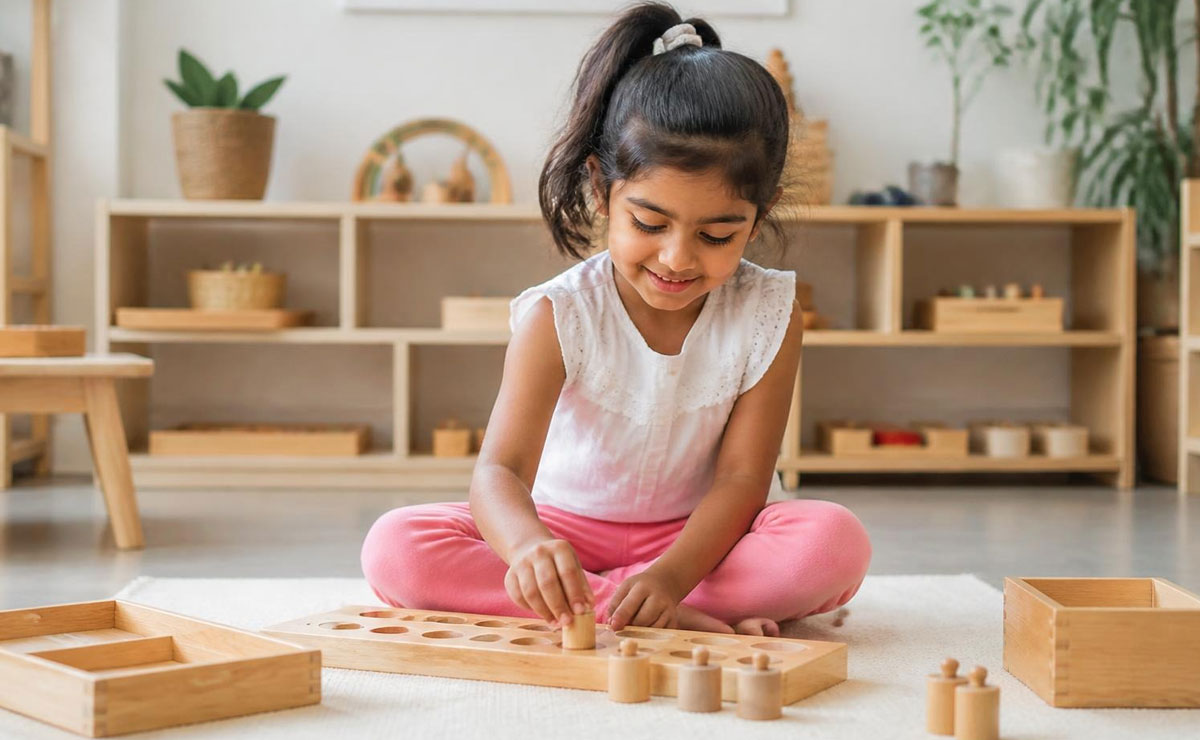
In recent years there is a lot of importance given to the concept of self esteem. Good self-esteem is considered a fundamental requirement for a person’s well being and success in life. Definitions of what exactly is meant by self esteem might vary but most would agree that it is a sense of belief in one’s worth and a feeling of competence.
How is this acquired? There is much talk about what we need to do to develop self-esteem in our children. A hundred years ago, without actually using that term, Dr. Montessori studied the nature of the child and developed an environment that provided opportunities for the child to develop his self esteem in every possible way.
HOW DOES A MONTESSORI ENVIRONMENT BUILD A CHILD’S SELF ESTEEM?
1. The Montessori Method does not believe in direct intervention or correction. That is the reason Dr. Montessori developed material that is self-correcting, so that a child is given the opportunity to discover things for himself. By making his own discoveries the child has a sense of achievement. In other types of learning environments, the main form of teaching is through correction. What happens to a child every time he is corrected? Every time he is told that he had written his ‘b” back to front or that his sums are not right? What happens when he sees red marks all over his work? He feels disheartened. The message he gets is that he knows nothing and that he is not good enough. He loses interest in the subject. In a Montessori environment the child arrives at things on his own, he discovers where he has gone wrong and has a great desire to improve, and as he progresses he knows this is due to his own efforts.He has a sense of competence.
2. In a Montessori classroom there is no comparison. No child is made to feel that since the other child is doing something, he must do it too. The mixed age group and independent work makes it all the more difficult for children to even compare themselves to each other. There is no peer pressure-that all children who are of a particular age must be at the same level. Thus when a child is allowed to move at her own pace and is accepted for what she is, she learns to be comfortable with herself. She works only with the desire to challenge herself and not with the goal of being better than someone else. This helps her discover her own strengths and develop into a truly self motivated individual.
3. The Montessori Method does not use criticism, threats or punishment in order to control or develop a child. Unfortunately the rest of society has still to understand that criticism or punishments only hurt a child’s self esteem. It makes children angry and rebellious. These methods do not help a child reflect on what is going wrong and where he needs to change. He only feels resentful and demotivated. In a Montessori environment a child is supported in building self discipline. When he breaks a rule he is reminded of the rule gently and guided to follow it. He does not feel humiliated. If his behaviour is disruptive or unacceptable, the teacher observes the child to find out what his need is. Understanding the need is more important than focusing on the behavior. Then she finds ways to channel his energies without labeling the child, thus keeping his self esteem intact.
USING MONTESSORI PRINCIPLES AT HOME TO BUILD SELF ESTEEM:
As a parent when I observed how a child is helped to grow with a positive self image in the Montessori environment I wondered why I could not apply the same principles at home. Did I need to keep correcting and admonishing my child for everything? Did I have to punish or make her feel bad “to teach her a lesson”? Why did I get into so much conflict and power struggle with her? Couldn’t I find ways of guiding her which are as respectful as those used in school? Did the way I interacted with her nurture her self esteem?
With these questions in mind I looked at how the same Montessori principles can be applied by parents in all situations so that a child is allowed to develop in his wholeness not bowed down with adult interference. These are some principles I decided to try out:
RESPECT: Dr. Montessori discussed at great length what it means to respect a child but this concept of respect is still not widely accepted across the world. As adults we have a notion that children have to respect and obey us. We know what is good for them. They do not know better; after all they are only children. With this ingrained in our minds we are unable to offer a child the respect he deserves. When a child starts to eat and his stomach is full, he turns his face to indicate that he wants no more. We are unable to respect that. We think “she needs to eat more and I will make her”. There begins our interference, which stops the child from developing her own judgment. The child wants to wear an old T shirt which is comfortable. In our opinion it is not appropriate for the occasion. We do not allow it. She gets the message that her choices are not good enough. In this manner there are innumerable ways in which each day we disrespect children. With this approach how do we hope to develop an individual who feels worthy and competent?
TRUST: Respect is closely linked to trust. We are unable to respect the child because we do not believe that he has the capacity to make good choices. We do not think he knows what he needs to do for his own growth. This is where Dr. Montessori, through her observation of children, discovered that every child is constantly striving towards his own development. Every child wants to challenge himself and every child is capable of learning to make decisions if given the right environment and structure. If many of our actions are guided by a lack of trust how can we hope that the child trusts his choices and believes in himself?
BOUNDARIES, EMPATHY AND SELF ESTEEM
Of course there are situations in which the child needs boundaries to be enforced by an adult. But this can be done with respect and trust in an empathetic manner. For example, instead of scolding the child for eating too many chocolates can we as adults avoid keeping these within reach, discuss with the child a fixed plan for one chocolate a day and when she cries, be able to say with empathy, “I know it’s hard. You love chocolates. You wish you could have more. Right now we have a rule that we eat only one chocolate a day.”
What you have done essentially is set a boundary for your child in an empathetic and respectful manner. Though it may not work the first time, you are laying the foundation for a relationship based on trust and respect, and that is a primary building block for their self esteem to flourish.
About the Author
This blog is written by Kesang Menezes, Co-founder of Parenting Matters and mother of two adult daughters. She says, “Parenting doesn’t come with a manual, but learning about parenting is the best gift we can give ourselves and our children.”


